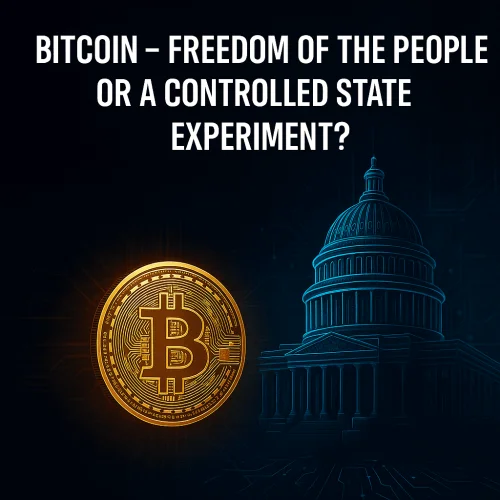
Bitcoin – Freedom of the People. In the debate about Bitcoin there are two narratives. The first is romantic. A brilliant mind or a small team of cypherpunks combined publicly available cryptography knowledge into an elegant system that gave people the first sovereign digital money. The second is harsher. The system of power released the technology “into the wild” as a controlled experiment, because it is useful in the transition to a new order – and therefore it was not banned while it was small and vulnerable. If we take cold history, precedents, and the way the world of power has dealt with money and gold so far, the second narrative does not sound unlikely at all.
Precedents: when the state wants, the state acts
The U.S. government has already shown that it can and will rewrite monetary rules. Executive Order 6102 from 1933 forced citizens to surrender private gold to banks under threat of fines and imprisonment. In 1971, the gold standard was abolished, the dollar lost its convertibility into gold, and the world swallowed it. In the digital era, every early attempt at private e-money with a central point was shut down or suffocated. Pioneers like e-gold and Liberty Reserve ended up under indictments and bans, while DigiCash disappeared as a business. If the state could do all that, it could have done the same to Bitcoin – if it had wanted to. It didn’t want to. That is the starting fact which opens the heavier hypothesis. The system assessed that Bitcoin, in its given form, does not harm it as much as it benefits it.
The technical DNA that feeds both theories
Bitcoin is a combination of publicly known components. Hashcash and proof-of-work, Merkle trees, P2P networking, timestamping, game theory around limited supply and halving. The hash function at the heart of Bitcoin, SHA-256, comes from NIST. Designed by the NSA; this is not proof of “who created Bitcoin,” but it is a real data point in the mosaic. On the other hand, it is precisely the openness of the code and the public ledger that gives the state a surprising advantage. All transactions are permanently visible. If you are an institution with resources for analytics, you gain a historic opportunity to observe global capital flows in real time, without a court order for each individual transaction. That is the paradox – what gave users permissionless freedom simultaneously created the largest financial data set ever.
Why it wasn’t banned when it could have been
If you look at state behavior through the lens of interests, four reasons appear. First is the laboratory. An open-source protocol in a “live” environment tests resilience, scaling, attack surfaces, and social dynamics for free. Second is transparency: unlike private cash systems, Bitcoin is a public ledger; for intelligence agencies this is a gold mine. Third is the ramps. Even the hardest protocol must enter the fiat world through exchanges, banks, and processors – and there lie KYC/AML, licenses, and kill switches. Fourth is narrative. As institutional interest grew, Bitcoin was transformed from “rebellion” into “digital gold,” a portfolio asset class under ETFs; the revolutionary charge was removed and it was absorbed into the existing architecture of capital.
If Bitcoin is a controlled experiment – what is the logic of the endgame?
The logic is transitional. The system that built fiat and global debt needs a pathway to the digital money of tomorrow. Time is needed for society to normalize cryptographic wallets, seed phrases, irreversible transactions. Bitcoin played the role of shock absorber and teacher. It showed that it is possible to have a global, permissionless protocol that lives without a central bank. While people are getting used to it, central banks develop their own projects and message standards (ISO 20022) which fit into the financial infrastructure. In the end, Bitcoin may remain as a “safety valve” and reserve asset, while real everyday payments go through CBDCs and permissioned networks, where rules and granular control are in the hands of the state. This is not necessarily the “destruction” of Bitcoin, but it is its domestication. An asset, not a currency; a valve, not the axle.
Arguments supporting the thesis “it did not survive by accident”
It survived despite disturbing the status quo. It was not killed by a coordinated ban in the early years. Although that could have been done technically and legally. The protocol’s foundations contain components originating in the state’s ecosystem. Its dissemination was initiated by an anonymous entity who disappeared when it was time to disappear; regulatory strategy focused on the ramps, not the protocol; as it grew, Wall Street was involved with the rhetoric of investor protection. All this together does not prove the origin, but it confirms that survival was aligned with the interests of power.
What remains of “freedom” if all of the above is true
The most important thing remains: the protocol runs without permission. No one can change the rules in your local copy; no one can retroactively invalidate a valid block without real costs; no one can seize keys you have not given up. These properties are the reason why Bitcoin became a systemic factor even if, in someone’s scenario, it was conceived as a transitional tool. As soon as you give millions of individuals a tool for self-custody outside of banking hours and across borders, you have changed history. Power can manage narrative, ramps, and taxes, it can capture the largest flows through institutional products – but it cannot erase the fact that a global, permissionless network exists and does not rely on a central switch.
Where the real fracture lies
It does not lie in the origin, but in the use. If Bitcoin is massively accepted only as a financial instrument in custodial accounts, then it is domesticated and integrated into the order. If self-custody, open-source software, free clients, and education are insisted upon, then its original essence survives despite everything. That is why the debate “is it a state project” is important for understanding power, but less important than the question of how people use it today. The system of power has already shown it can change the rules; people can only fight back by mastering the rules that cannot easily be changed – mathematics, keys, and protocols.
Honest conclusion
My thesis stands: if the state had wanted to, it could have banned it in its early phase – it didn’t. That is the strongest indication that it was allowed to live because it was useful. At the same time, the fact that there still exists a global, permissionless protocol that gives the individual power outside of banking hours and beyond national borders – that is revolutionary, regardless of origin. Two truths can be valid at the same time: Bitcoin may have been released as a controlled experiment, and yet it gave people a tool no government had ever allowed before. The outcome depends on whether its use will be defanged through custody and regulated ramps, or whether users will keep it as what it truly is – a network that calculates, not one that asks permission. Bitcoin – Freedom of the People.
👉 Znanjem protiv hajpa – uvijek sigurniji put!
Vas Petar Miljić – Finansije za narod
Ne zaboravite: budućnost se ne gradi kad svi već znaju za nju – već onda kad je vide samo rijetki.
🔥 Budućnost pripada onima koji misle dugoročno. 🔥
Jedno je sigurno – budućnost kripta neće biti dosadna!
Više edukativnih članaka možete pronaći na našoj web stranici kanalu kriptoentuzijasti.io i diskord platformi discord.gg/kriptoentuzijasti
#Crypto #Bitcoin #BullRun2025
💬 Discord zajednica: discord.gg/kriptoentuzijasti
🐦 X (bivši Twitter): @k_entuzijasti
📌 Preporučeno za čitanje: Podaci s lanca potvrđuju snagu kripto tržišta Geopolitika hashratea – Tko zaista kontrolira Bitcoin mrežu?
Pročitajte i: Povijest se ponavlja
Hvala svima što čitate naše članke na kriptoentuzijasti.io! 🚀 Ako vam se sviđa ono što čitate, podijelite ih na društvenim mrežama i pomozite nam širiti kripto znanje. Zajedno gradimo svijet kripta! 💪🔗 #Kriptoentuzijasti #Dijeliznanje crypto #Kriptoedukacija #EtherX #društevenamreža #Crypto # binance istraga